Carbon offsetting
Are you thinking about offsetting your carbon footprint?
In average each European emits 7.2 tons of CO2 every year. However, according to the scientific community, in order to avoid catastrophic consequences, we should emit a maximum of 2.3 tons per person per year.
In the richest countries, like Europe and North America, traveling can be a big part of one's footprint.
In order to get a concrete idea about what the impact of flying is, see the following examples:
-
A flight from Rome to Mallorca takes 1 hour and 45 minutes.
A total of 400 kg CO2 per passenger are emitted in a return journey. -
A flight between Barcelona and Stockholm takes 3 and half hours.
About 1 ton CO2 per passenger is emitted in a round-trip. -
Flying from Paris to Tokio takes 14 hours.
More than 6 tons CO2 per passenger are emitted in a round-journey.
In this article we will explain everything you need to know in order to come to responsible decisions when traveling, so you can do your part in contributing to fight climate change.
Among others, we will answer the following questions:
How offsetting CO2 works
1. Reduce your CO2 footprint as much as possible
First of all, it is very important to reduce our CO2 as much as possible.
Simplifying it a lot, we could compare it with our kitchen. Remember that sauce that you dropped last time and let it dry out before cleaning it? Is it not much better to be careful and avoid making a mess in the first place instead of having to clean it up later on?
Plus being careful also avoids the risk of getting an unlucky tomato sauce stain at your white wall that you cannot remove anymore, having to buy extra cleaning products at the supermarket and arguing with your partner or flatmate.

Better avoiding a mess than having to clean it up later.... Photo by Tyler Nix in Unsplash.
With our carbon footprint it is very similar, but our kitchen turns out to be our planet and the sauces we drop are tons of CO2: first of all, be careful and try to avoid the mess.
How to reduce your CO2 footprint?
Following this principle, the first step is to think what alternatives do we have in order to reduce our footprint when planning a trip.
If you are planning a business trip, do you really need to take the plane? Why don’t you organise a videoconference instead?
Traveling by train can also be an alternative. Even though it takes longer, you can use this time efficiently for getting work done without interruptions.
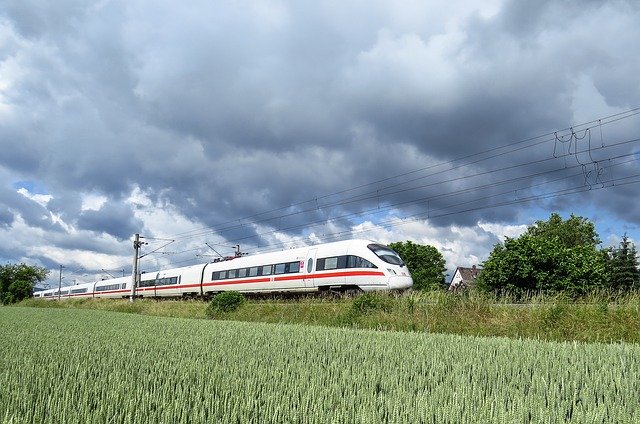
Trains are an alternative especially interesting to flights when the duration of flying is less than two hours. Photo by 2182694 in Pixabay.
If we were talking about a leisure trip, we could claim the same questions:
Do you really need to fly there?
Maybe choosing a closer destination, which is also worth visiting and which you can travel to by ground transportation, can appear as an alternative.
If this is not a solution for you, choosing a direct shorter flight instead of going overseas might be another option. For instance, if you live in Europe, did you know that Menorca has even prettier beaches than Bali?
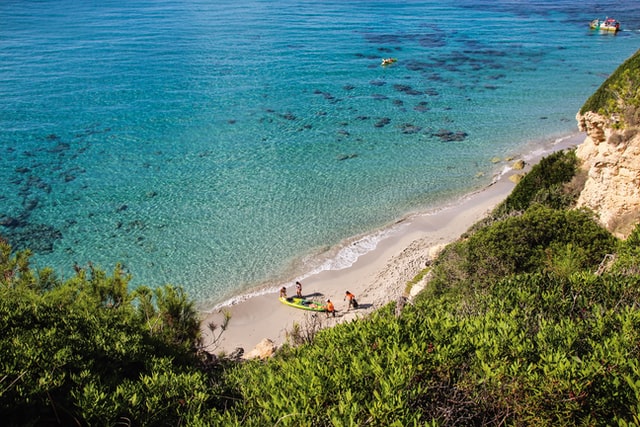
There is not need to cross the globe to find breathtaking beaches. Photo by Joan Mesquida in Unsplash.
2. Offset the rest of CO2 that you did not manage to reduce
The second step is compensating all the CO2 that you were not able to avoid emitting in the first place.
Each trip has an environmental impact. Transportion needs energy, and to obtain this energy we emit greenhouse gases like CO2.
Carbon offsetting is about funding projects, which reduce greenhouse gases in the atmosphere.
These projects calculate the total emissions they avoid and the money needed to make this reduction happen.
With your donation, you contribute financially to the project and those carbon savings are attributed to you.
Example:
Unfortunately this is just a theoretical calculation: offseting is much better than doing nothing about the impact of your trip, but it is not a wild card to unlimited travel.
This is why offsetting should come only after reducing your CO2 footprint as much as possible.
Why is offsetting not perfect?
Even if you select the appropriate project (more on that later), offsetting your CO2 footprint is not exactly the same as reducing it.
The main reason is the delay between emission and offset. As explained in Founders Pledge, "it is very unlikely that any offsetting scheme you fund will offset your carbon at exactly the same time as you emit". "The CO2 you initially emit does harm people by causing warming. Even though you reduce emissions one month later, this harm has still been done".
This includes not only
- when the project will be implemented. For instance, in the case of more efficient stoves, when they will be installed.
- its lifespan until the full amount of carbon is avoided or captured. In the case of the stoves, each time they are used, a small amount of carbon will be avoided. However, it will take months or years until the full amount if avoided and the offsetting completed.
Why is offsetting needed?
You can see offsetting as an intermediate solution until we figure out how to really solve this problem.
Some argue that what we need is a cultural change, so we all travel much less.
Others argue that new techonlogies will come and will make clean long-distance traveling possible.
Nobody knows which solution will eventually work; but what we know is that finding it will take time. Time we are running out of.
This is why in the present and in the near future CO2 offsetting has a critical role to play.
if you travel, offsetting your carbon footprint makes a difference.
What kinds of projects allow offsetting carbon emissions?
- Projects that avoid CO2 emissions.
- Projects that capture CO2.
Avoiding CO2 emissions
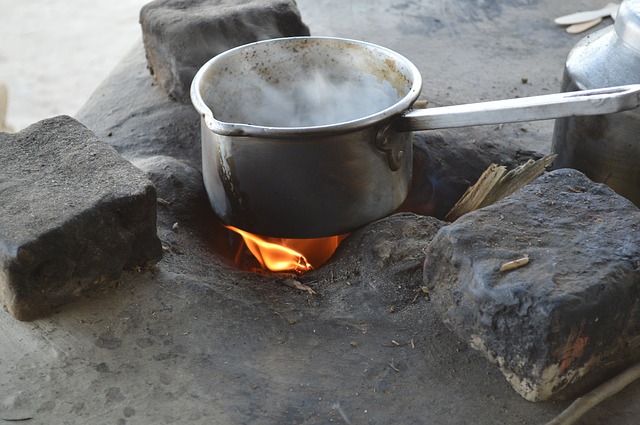
Efficient stoves avoid that trees are cut and wood burned. Photo by nasircoolboy1 in Pixabay.
Projects that avoid CO2 emissions are for instance:
- Efficient stoves in developing countries, reducing the needs of wood.
- Biogas digesters, using waste to generate electricity and heat.
- Wind parks, generating electricity without emitting greenhouse gases.
The saved emissions, thanks to your contribution funding the projects, compensate the ones you have emitted.
Capturing CO2
Projects that capture CO2 from the atmosphere are for instance planting trees or protecting forests from being cut down.
Forests are able to absorb CO2 from the atmosphere extremely efficiently compared with any other method or technology available.
Furthermore, they contribute in many other positive ways:
- They protect against droughts, desertification, landslides and floods.
- Forests supply fruits to the local population. They can use them to feed their families or to generate an income.
- They are home to many endangered species and are key to maintain biodiversity.
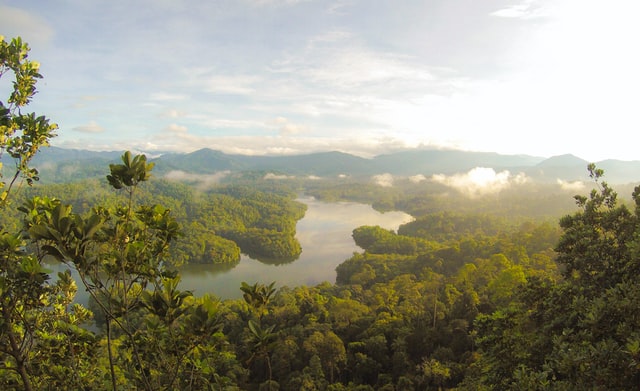
Balok rainforest, Malaysia. Photo by Eutah Mizushima in Unsplash.
However, following the advice of many experts, we do not recommend forestry projects to offset carbon.
Why?
- First of all, it is very complicated to quantify exactly how much CO2 is really captured.
- In addition, when planting trees, many decades need to go by so that the trees absorb a relevant amount of CO2. Our emissions, on the other side, have an immediate impact.
-
In certain projects, only one sort of tree is planted along very large areas. This does not help recovering biodiversity and ends up eroding the soil.
If this wasn’t convincing enough yet: decades later these trees are cut down and the timber gets sold.
Such cases happen especially in projects, where they only show interest in marketing themselves as green, even if they actually don't care about the environment. This is also known as greenwashing. greenwashing.
Luckily, travellers willing to offset their CO2 can avoid falling in this trap by making sure that the projects are verified (more on that later). -
Last but not least, it is impossible to guarantee that in the mid and long term the carbon stays at the ground and does not go back to the atmosphere.
Through fires, illegal deforestation for timber or even the natural cycle of trees during its decomposition make that at least one part of the absorbed carbon is eventually being released again.
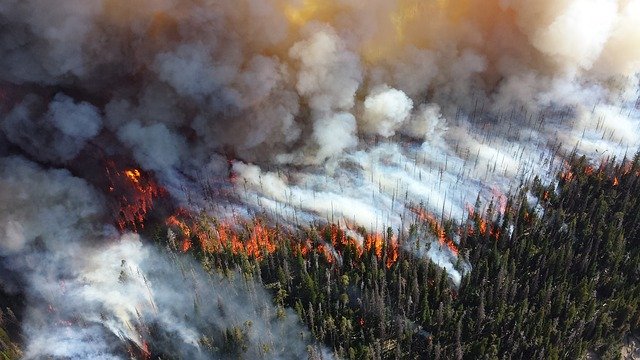
Fires release back most of the captured carbon. Photo by skeeze in Pixabay.
Taking all this into account, the conclusion is:
Planting trees is extremely beneficial. Preserving forests is vital to avoid that even more carbon is released. However, this is not the best way to offset your carbon footprint.
For this purpose, we recommend to invest in projects that avoid carbon emissions.
Where can I offset my footprint?
Some airlines offer the option of offsetting your footprint when booking a flight.
Any initiative to fight climate change is welcome. Therefore, if you want a very simple and straightforward solution, this might be the best way for you.
However, if you want to make sure that the offsetting is as fair and reliable as possible, it is better to offset your footprint independently.
Every airline has its own interests and priorities, which might or might not include taking care of our planet. This is why it is more reliable to use websites specialized in offsetting CO2 which present their main interest in saving the environment.
Websites specialized in offsetting carbon
| Website | Cost per ton of CO2 | Languages |
|---|---|---|
| CoolEffect | $5 - $11 | English |
| atmosfair | 23€ | English, German |
| myclimate | 24€ | English, German, French |
CoolEffect
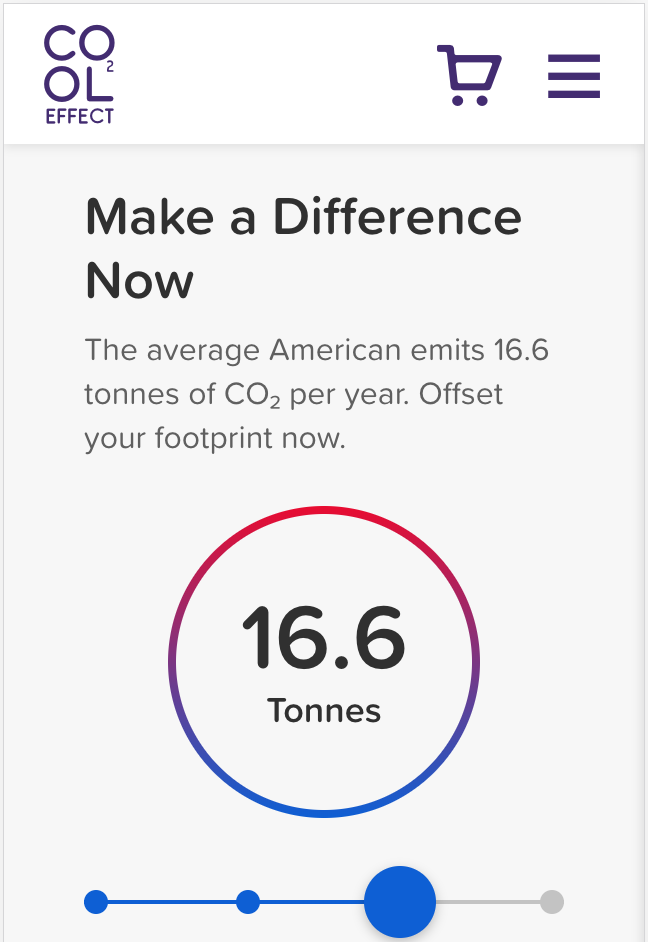
CoolEffect is the most popular website in the US to offset your carbon footprint.
Their projects for carbon offsetting include:
- Efficient stoves that reduce the need of wood.
- Biogas digestors that use waste to produce energy and manure.
- Wind and solar farms.
With CoolEffect you can very easily calculate your flight's carbon footprint.
Once you know how much carbon you have emitted, you can:
- Directly make a generic contribution.
-
Select one project of their list and insert there the amount of carbon calculated previously.
For each project you can find a detailed description, the cost of offsetting one ton of CO2, and the verifications of that certain project.
The average carbon price is about $8/ton. If you want to donate to a specific project, the cost ranges between $5 and $11 per ton.
Due to its user-friendly interface and the low cost of each ton, this is the option that we like the most, as long as you make sure that you select a project that has the Gold Standard verification (the strictest one).
At the moment of this writing, the most efficient projects in terms of cost per ton of carbon and fullfilling the strictest verifications are the biogas digestors.
Payments are only accepted in dollars.
atmosfair

atmosfair is one of the two most popular European websites to offset carbon.
Its interface is also very user-friendly. The cost of offsetting carbon is 23€/ton.
The difference in the price of the carbon, compared with CoolEffect, is significant. This is because atmosfair is extremly rigorous with the projects they select and they take the extra step to make sure that the projects are not only good for the planet but also for local communities.
For example, they do not include any forestry projects, since they cannot ensure that the carbon captured by the trees planted or protected will not be released again in the future. They even have an article explaining in detail Why doesn't atmosfair plant any trees?.
Another advantage of atmosfair is that their CO2 emissions calculator for flights is one of the most accurate you can find.
The website is available in English and in German.
MyClimate.org
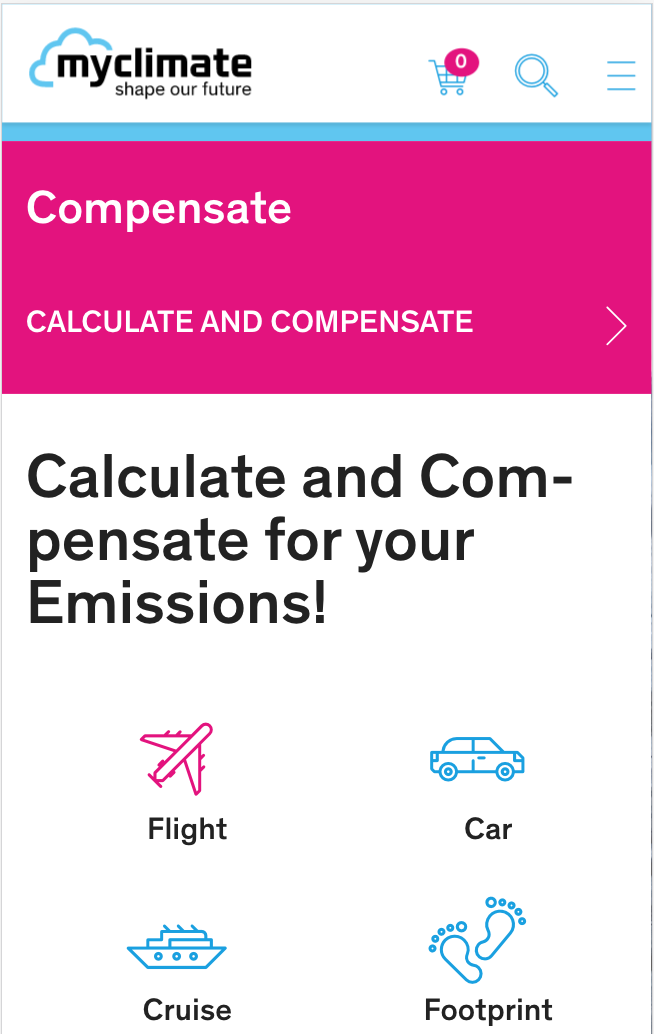
MyClimate.org is another very popular website in Europe for carbon offsetting.
This Swiss website also has its own CO2 calculator. The cost of offsetting carbon is 24€/ton.
The website is available in English, French and German.
Verifications
If we want to make sure that the donation to offset our footprint achieves its purpose, it makes sense than an external organization supervises the project. This is exactly what the verifications are for.
The most popular verifications are:
Gold Standard
The Gold Standard verification (GS-VER) is managed by the Gold Standard Foundation, which is a non-profit organization located in Switzerland.
It is considered the strictest verification for projects of environmental protection and it is supported by some NGOs like the WWF.
Plan Vivo
Plan Vivo is a certification created by the Plan Vivo Foundation, a Scottish non-profit organization.
VCS Verra
The Verified Carbon Standard (VCS) is one of the most popular programs worldwide. It is developed and managed by Verra.
Verra is a non-profit organization founded in Washington DC in 2005. It develops and manages verification standards to reduce carbon emissions.
CCBS
Climate, Community & Biodiversity Standards were developed by a group of organizations, including NGOs Conservation International, The Nature and Rainforest Alliance.
It is managed by Verra and specializes in projects that simultaneously fight climate change, support local communities and maintain biodiversity.
Socialcarbon
SOCIALCARBON is a standard developed by Ecologica Institute (the first Brazilian NGO specialized in climate change).
It certifies projects that reduce carbon and contribute to a sustainable development.
FSC
FSC or Forest Stewardship Council is specialized in forest management.
We hope you have now a better understanding of how carbon offsetting works.
If you have any question or comment about this topic, feel free to write to us through email or social media.
If you liked it, share it so the message gets to more travelers.
- CO2. Header picture from geralt in Pixabay.